Target
The Target options specify target-specific features for the IAR C/C++ Compiler and Assembler.
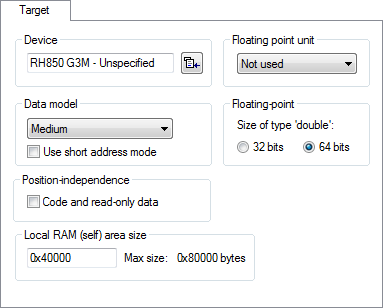
Device
Use this option to specify the processor core family and device your are developing for. For a description of the available core variants, see the the documentation from Renesas.
The choice of device will automatically determine the default linker configuration file and C-SPY® device description file. For information about how to override the default files, see Config andSetup, respectively.
Data model
Specifies the default memory type for data. Use the Data model option to choose the data model for your project.
Your choice of data model determines the availability of data model options.
- Small
Places data in a 64-Kbytes area anywhere in memory.
- Medium
Places data in 8 Mbytes RAM and 8 Mbytes in ROM. Only available for the V850E2M core and above.
- Large
Places data in the entire 4 Gbytes of memory.
For more information about the data models, see Data models.
Use short address mode
Uses the efficient short addressing mode for your project; to place the data in the saddr area, a 256-byte section of the default memory area. See saddr (short addressing) for more information.
Floating-point unit
Enables the floating-point unit. Choose between:
- Not used
Does not use the floating-point unit.
- Single precision
Uses the floating-point unit for 32-bit operations.
- Double precision
Uses the floating-point unit for all operations.
The drop-down list looks slightly different for different drivers. If the selected device does not have a floating-point unit, the setting will be Not available.
For more details about the floating-point unit, see the hardware documentation for your microcontroller.
Floating-point
The compiler represents floating-point values by 32- and 64-bit numbers in standard IEEE 754 format. Size of type 'double' selects the size of the type double; choose between:
- 32 bits
The data type
doubleis represented by the 32-bit floating-point format.- 64 bits
The data type
doubleis represented by the 64-bit floating-point format.
For more information about the floating-point format, see Basic data types—floating-point types.
Code and read-only data
Makes the compiler generate code that uses position-independent references to address code and read-only data.
Note
Data pointer constants cannot be initialized with the address of a movable object. However, writable variables can be initialized to constant addresses at runtime.
For more information about support for position independence, see Position-independent code and data.
Local RAM (self) area size
For multicore devices, this is the amount of RAM allocated to Local RAM (self) and the remaining RAM will be allocated to Local RAM (CPU n). For single-core devices with two logical areas for the same physical RAM, this is the amount of RAM allocated to Local RAM (mirror) and the remaining RAM will be allocated to Local RAM.
Note
The stack section is located in the Local RAM (self/mirror) area; make sure to allocate enough space for it.
This option overrides the size of the Local RAM (self/mirror) area specified in the linker configuration file. For more details about the Local RAM areas, see Shared RAM areas.