Library Configuration
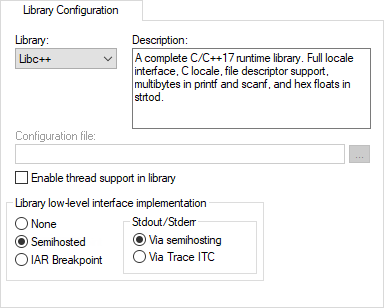
The Library Configuration options determine which library to use.
For information about the runtime library, library configurations, the runtime environment they provide, and the possible customizations, see The DLIB runtime environment.
Library
Selects which runtime library to use. For information about available libraries, see Prebuilt runtime libraries.
The names of the library object file and library configuration file that actually will be used are displayed in the Library file and Configuration file text boxes, respectively.
Configuration file
Displays the library configuration file that will be used. A library configuration file is chosen automatically depending on the project settings. If you have chosen Custom in the Library drop-down list, you must specify your own library configuration file.
Enable thread support in library
Select this option to automatically configure the runtime library for use with threads.
Library low-level interface implementation
Controls the type of low-level interface for I/O to be included in the library. Choose between:
- None
No low-level support for I/O available in the libraries. You must provide your own
__writefunction to use the I/O functions part of the library.
- Semihosted
Semihosted I/O using RISC-V standard semihosting.
Stdout/Stderr
Determines which method the executing application uses to send text to the stdout and stderr streams. Choose between:
- Via semihosting
Text is sent to the
stdoutandstderrstreams using the low-level interface for I/O selected to the left.
- Via Trace ITC
Text is sent to the
stdoutandstderrstreams by way of trace output, using the Instrumentation Trace Component present on some SiFive devices.